
What does it take to reach the pinnacle of success?
That’s the question that haunts many of us. We look at the people who seem to have it all, the accolades, the money, the recognition, the standing ovations, and we wonder – is that enough? Does reaching the top of your field finally answer the deep questions we carry about meaning and purpose?
Pistol Pete Maravich spent his entire life answering that question. And his answer might surprise you.
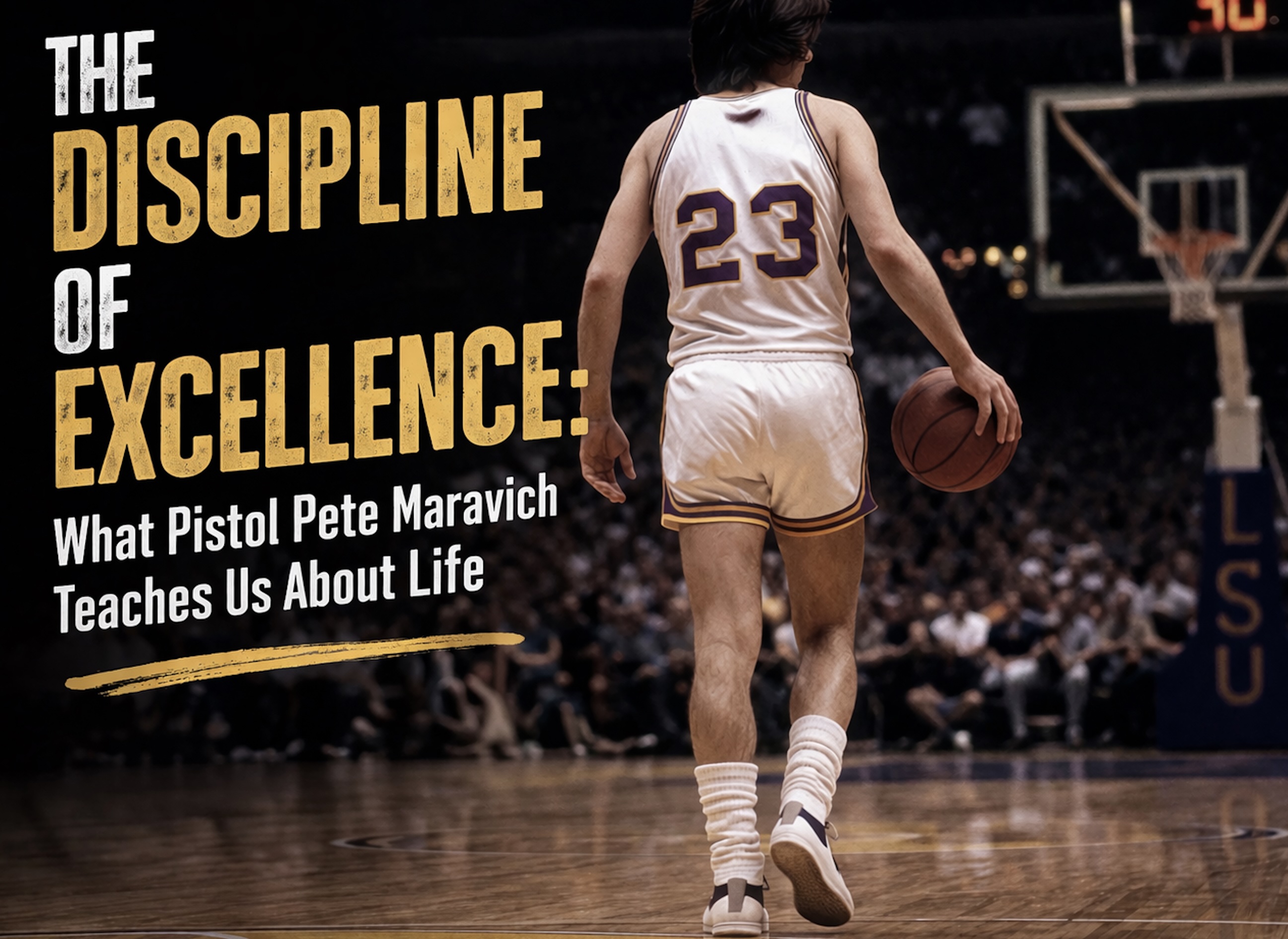
The Foundation: A Father’s Vision
Before Pete Maravich became a legend, before the arenas filled with fans eager to watch him play, there was a father named Press Maravich who had a vision. He believed his son could be great, not eventually, not someday, but through relentless, daily discipline.
So Press did something unconventional. He made Pete practice everywhere. Not just on the court, but in the car. As they drove down the street, Pete would dribble a basketball out the window while his father drove. The ball would bounce off the pavement, the railroad tracks, the curb — anywhere and everywhere. It wasn’t glamorous. It wasn’t Instagram-worthy. It was just a father and son, committed to the small, daily practices that separate the good from the great.
This wasn’t punishment. This was love expressed through discipline. This was a father saying: “I believe in you so much that I’m going to push you to be better than you thought possible.”
The Long Road to Mastery
That childhood discipline carried Pete through his college years at Louisiana State University. By the time he finished his NCAA career, he had set a scoring record that would stand for decades — 3,667 points before the three-pointer was even introduced to the game. Let that sink in. In an era when the three-pointer didn’t exist, Pete Maravich was scoring at a rate that seemed almost impossible.
How? The same way his father had taught him. Through discipline. Through showing up. Through the railroad tracks and the car windows and the relentless commitment to getting one percent better every single day.
His peers knew it. Larry Bird, one of the greatest shooters ever to play the game, said that Pistol Pete was “one of the truly great players that could fill an arena.” Pat Riley, the legendary coach, said Pete was “the original. He was the best ball handler I ever saw. Ever.” These weren’t casual compliments. These were tributes from people who understood excellence because they pursued it themselves.
The Peak: Success, But at What Cost?
Pete Maravich made it to the NBA. He became an All-Star. He won scoring titles. He was one of the highest-paid rookies in the history of professional basketball. By every worldly measure, he had succeeded. He had climbed the mountain and planted his flag at the summit.
But here’s where Pete’s story takes a turn that most success stories don’t.
Because despite all of that, despite the money, the fame, the accolades, the respect of his peers, something was still missing. There was still an emptiness that no championship could fill, no scoring record could satisfy, no standing ovation could quiet.
Jesus said it this way: “What good is it for someone to gain the whole world, yet forfeit their soul?” Pete Maravich had gained the world. And he was beginning to realize that the world, in all its glory and recognition, was not enough.
The Real Turning Point
It wasn’t until later in his life that Pete Maravich found what he was actually looking for. He became a Christian. And when he did, everything came into focus. The discipline he had learned from his father, the relentless pursuit of excellence, the commitment to daily practice, the willingness to show up even when no one was watching, suddenly had a new direction. It had a new purpose. It had a soul.
Pete spent his later years speaking about his faith, about the emptiness of worldly success, about the fulfillment that only comes from a relationship with God. He went from playing to packed arenas to speaking in churches. He went from chasing scoring records to chasing something infinitely more valuable: meaning, purpose, and peace.
The Bridge: From Basketball to the Spiritual Life
Here’s what Pete Maravich’s life teaches us: Excellence is not bad. Discipline is not wrong. The pursuit of mastery in your field, whether that’s basketball or business or art or ministry, is noble and good.
But excellence in one area of life, without excellence in the spiritual life, leaves you empty.
Think about the discipline Pete learned from his father. Dribbling out the car window. Practicing when no one was watching. Showing up day after day after day. Getting marginally better. That’s not a basketball principle. That’s a life principle.
The same discipline that made Pete Maravich the greatest scorer in NCAA history can make you spiritually mature. The same commitment to daily practice that filled arenas can fill your soul. The same willingness to show up when it’s hard, when it’s not glamorous, when no one is watching, that’s what builds a life of genuine faith and purpose.
The Question Answered
So back to the question we started with: What does it take to reach the pinnacle of success?
Pete Maravich would tell you that reaching the pinnacle of your field is wonderful. Go for it. Practice like your life depends on it. Be disciplined. Be excellent. Be great.
But don’t stop there.
Because the real pinnacle, the real success that actually satisfies is found not in what the world can give you, but in what God offers. It’s found in discipline applied not just to your craft, but to your spiritual life. It’s found in showing up, day after day, to pursue excellence in knowing God, in growing in faith, in becoming the person He created you to be.
Pete Maravich learned to dribble a basketball out a car window. But the greater lesson his life teaches us is this: discipline the soul the way you discipline the body. Practice faith the way you practice your craft. Show up for your spiritual life the way you show up for the things the world celebrates.
Because in the end, that’s the only success that lasts.
David Almgren – Two Pastors, Popcorn and a Movie Podcast
 Faith and Family Flicks News and Notes