
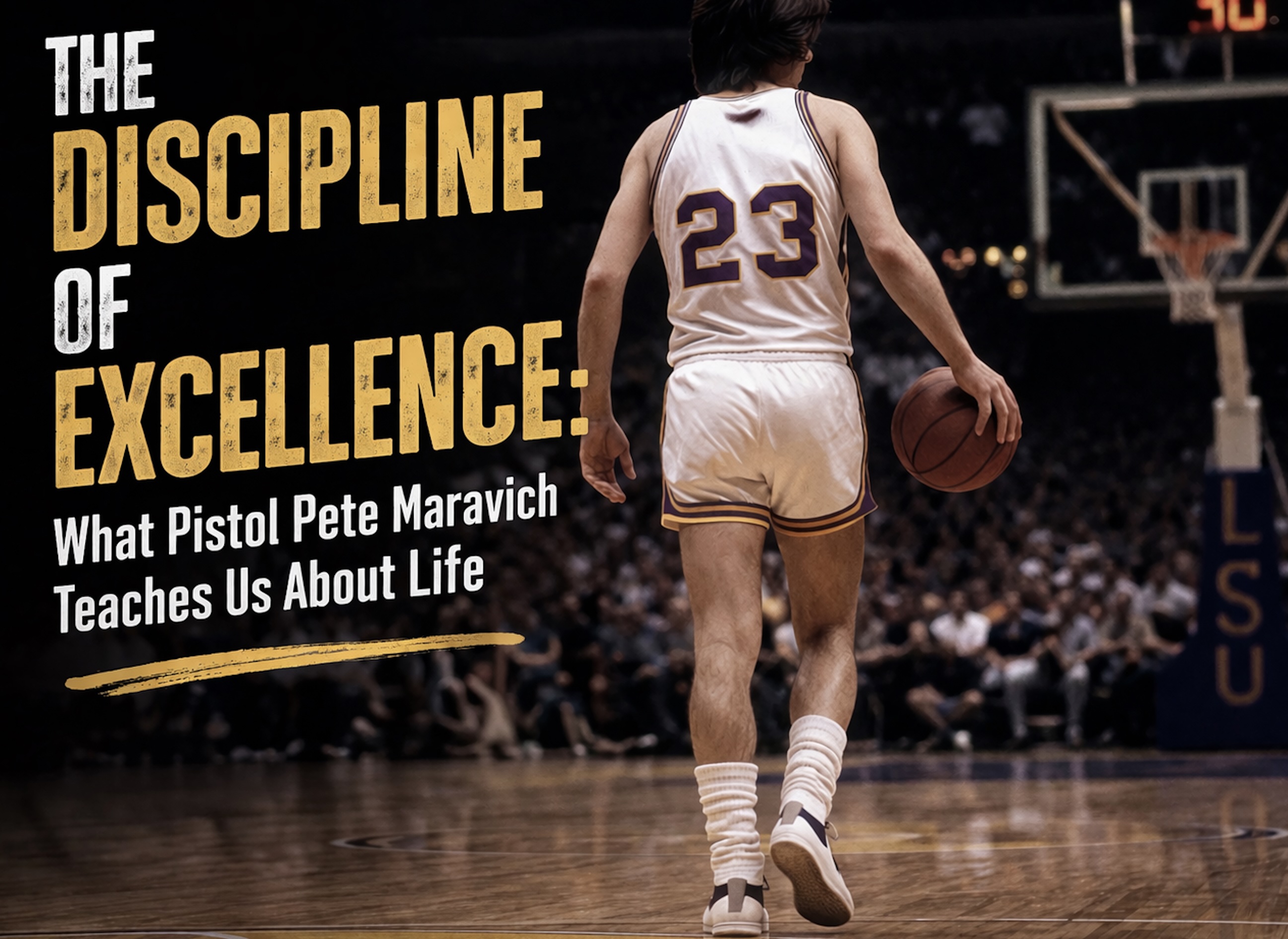
The Discipline of Excellence: What Pistol Pete Maravich Teaches Us About Life

What does it take to reach the pinnacle of success?

That’s the question that haunts many of us. We look at the people who seem to have it all, the accolades, the money, the recognition, the standing ovations, and we wonder – is that enough? Does reaching the top of your field finally answer the deep questions we carry about meaning and purpose?

Pistol Pete Maravich spent his entire life answering that question. And his answer might surprise you.
Screenshot

The Foundation: A Father’s Vision

Before Pete Maravich became a legend, before the arenas filled with fans eager to watch him play, there was a father named Press Maravich who had a vision. He believed his son could be great, not eventually, not someday, but through relentless, daily discipline.

So Press did something unconventional. He made Pete practice everywhere. Not just on the court, but in the car. As they drove down the street, Pete would dribble a basketball out the window while his father drove. The ball would bounce off the pavement, the railroad tracks, the curb — anywhere and everywhere. It wasn’t glamorous. It wasn’t Instagram-worthy. It was just a father and son, committed to the small, daily practices that separate the good from the great.

This wasn’t punishment. This was love expressed through discipline. This was a father saying: “I believe in you so much that I’m going to push you to be better than you thought possible.”

The Long Road to Mastery

That childhood discipline carried Pete through his college years at Louisiana State University. By the time he finished his NCAA career, he had set a scoring record that would stand for decades — 3,667 points before the three-pointer was even introduced to the game. Let that sink in. In an era when the three-pointer didn’t exist, Pete Maravich was scoring at a rate that seemed almost impossible.

How? The same way his father had taught him. Through discipline. Through showing up. Through the railroad tracks and the car windows and the relentless commitment to getting one percent better every single day.

His peers knew it. Larry Bird, one of the greatest shooters ever to play the game, said that Pistol Pete was “one of the truly great players that could fill an arena.” Pat Riley, the legendary coach, said Pete was “the original. He was the best ball handler I ever saw. Ever.” These weren’t casual compliments. These were tributes from people who understood excellence because they pursued it themselves.

The Peak: Success, But at What Cost?

Pete Maravich made it to the NBA. He became an All-Star. He won scoring titles. He was one of the highest-paid rookies in the history of professional basketball. By every worldly measure, he had succeeded. He had climbed the mountain and planted his flag at the summit.

But here’s where Pete’s story takes a turn that most success stories don’t.

Because despite all of that, despite the money, the fame, the accolades, the respect of his peers, something was still missing. There was still an emptiness that no championship could fill, no scoring record could satisfy, no standing ovation could quiet.

Jesus said it this way: “What good is it for someone to gain the whole world, yet forfeit their soul?” Pete Maravich had gained the world. And he was beginning to realize that the world, in all its glory and recognition, was not enough.

The Real Turning Point

It wasn’t until later in his life that Pete Maravich found what he was actually looking for. He became a Christian. And when he did, everything came into focus. The discipline he had learned from his father, the relentless pursuit of excellence, the commitment to daily practice, the willingness to show up even when no one was watching, suddenly had a new direction. It had a new purpose. It had a soul.

Pete spent his later years speaking about his faith, about the emptiness of worldly success, about the fulfillment that only comes from a relationship with God. He went from playing to packed arenas to speaking in churches. He went from chasing scoring records to chasing something infinitely more valuable: meaning, purpose, and peace.

The Bridge: From Basketball to the Spiritual Life

Here’s what Pete Maravich’s life teaches us: Excellence is not bad. Discipline is not wrong. The pursuit of mastery in your field, whether that’s basketball or business or art or ministry, is noble and good.

But excellence in one area of life, without excellence in the spiritual life, leaves you empty.

Think about the discipline Pete learned from his father. Dribbling out the car window. Practicing when no one was watching. Showing up day after day after day. Getting marginally better. That’s not a basketball principle. That’s a life principle.

The same discipline that made Pete Maravich the greatest scorer in NCAA history can make you spiritually mature. The same commitment to daily practice that filled arenas can fill your soul. The same willingness to show up when it’s hard, when it’s not glamorous, when no one is watching, that’s what builds a life of genuine faith and purpose.

The Question Answered

So back to the question we started with: What does it take to reach the pinnacle of success?

Pete Maravich would tell you that reaching the pinnacle of your field is wonderful. Go for it. Practice like your life depends on it. Be disciplined. Be excellent. Be great.

But don’t stop there.

Because the real pinnacle, the real success that actually satisfies is found not in what the world can give you, but in what God offers. It’s found in discipline applied not just to your craft, but to your spiritual life. It’s found in showing up, day after day, to pursue excellence in knowing God, in growing in faith, in becoming the person He created you to be.

Pete Maravich learned to dribble a basketball out a car window. But the greater lesson his life teaches us is this: discipline the soul the way you discipline the body. Practice faith the way you practice your craft. Show up for your spiritual life the way you show up for the things the world celebrates.

Because in the end, that’s the only success that lasts.

David Almgren – Two Pastors, Popcorn and a Movie Podcast

Are You a Thermometer or a Thermostat?

We live in a world that is constantly trying to shape us. Pressures come from every direction, culture, circumstances, relationships, uncertainty—all of it working to pull us away from who we are meant to be. The question is not whether we will face these pressures. The question is, will we simply reflect them, or will we actively resist them?

Think about a thermometer and a thermostat. A thermometer is passive. It reads the temperature around it and displays what already exists. A thermostat, on the other hand, is active. It measures the environment, yes, but then it works to change it. It sets a standard and refuses to settle for anything less. In life, we’re constantly choosing between these two modes.

Most of us drift between them without even realizing it. Some days we’re thermometers, passively absorbing whatever our surroundings throw at us. We react to stress, negativity, doubt. We let circumstances dictate our mood, our choices, our direction. But other days—the better days—we become thermostats. We make deliberate choices that shape not just ourselves but the people and spaces around us.

The ancient proverb warns us about this drifting: “All we like sheep have gone astray.” There’s something in our nature that pulls us off course. We’re not naturally inclined to stay true. And there’s a spiritual principle here that’s worth understanding. There’s a phrase about sin that captures this perfectly: it will take you further than you want to go, make you pay more than you want to pay, and make you stay longer than you want to stay. Environment shapes behavior. What we take in influences what we give out. And if we’re not vigilant, we end up somewhere we never intended to be.

For those of us who follow Christ, there’s a framework for understanding this. Romans reminds us that we’ve all sinned and fallen short. But it also tells us about God’s gift of eternal life through Jesus. The key is recognizing that staying true isn’t something we do alone. It’s something we do in constant connection with our faith, our community, our spiritual practices.

Think of a carpenter’s plumb line. It’s a simple tool, a weight on a string—but it ensures that what’s being built is perfectly vertical, perfectly true. If you’re off by just a fraction at the beginning, by the time you’ve built several stories, you’re completely crooked. The same principle applies to our lives. Small deviations compound. A slight tilt to the right or left, ignored long enough, and you’re no longer heading toward your destination.

NASA understands this principle too. When a rocket launches toward the moon, if its trajectory is even slightly off in those first moments, it will miss the mark entirely. Space is vast and unforgiving. Precision matters from the very beginning.

During the pandemic, I experienced this firsthand. Anxiety and overwhelming uncertainty crept into my mind each day. The future felt unknowable. Fear wanted to be my constant companion. But I discovered something that became my anchor: Scripture. Promises from God’s Word. When I quoted those promises—when I reminded myself of my identity in Christ, of the certainty I have as a believer, I could take my eyes off the uncertain and fix them on something immovable. That practice of recalibration, of constantly returning to truth, saved me.

And here’s the thing: it wasn’t just a daily practice. Some days it was hourly. Some moments it was minute by minute. Staying true requires vigilance. It’s like flying an airplane. You can’t fall asleep at the controls. You can’t look away from your instruments. You have to be constantly aware of where you are, who you’re with, and whether you’re still on course.

Which brings me to the maps application on your phone. You punch in a destination, and the app guides you turn by turn. But the moment you deviate, the moment you turn left when it says turn right, the app doesn’t give up on you. It simply recalculates. “Recalibrating, recalibrating, recalibrating.” It keeps adjusting until you’re back on course. Sometimes the recalibrated route takes longer. Sometimes you wonder if you’ll ever arrive. But the alternative to following those recalibrations is getting completely lost.

That’s the spiritual reality too. Daily recalibration keeps us on point toward our destination. And what is our destination? To finish the race well. To serve the Lord with all our heart, mind, soul, and strength. To refuse to become a casualty to a culture that wants to destroy us spiritually. To keep our eyes fixed on heaven.

The films “The Forge,” “Soul on Fire,” and “Woodlawn” each illustrate this truth in different ways. “The Forge” shows us the power of mentorship and discipleship, being shaped by someone further along the journey. “Soul on Fire,” based on Jon O’Leary’s remarkable true story, shows us something even more profound. O’Leary survived burns covering ninety-five percent of his body as a young boy. He could have been defined by tragedy. He could have let his circumstances be his thermostat, setting the temperature of his life at despair. Instead, he chose to be a thermostat himself. He rose above the pain, transformed his suffering into purpose, and now influences countless others through his resilience and faith. And “Woodlawn” shows us what it looks like to hold true north even when the world pressures you to compromise, to abandon your convictions for comfort or acceptance.

These aren’t just inspiring stories. They’re blueprints. They show us that recalibration is possible. That staying true is possible. That becoming a thermostat instead of a thermometer is a choice we can make, again and again, as many times as we need to.

Your spiritual practices matter: prayer, scripture reading, community, confession, accountability. These aren’t optional extras. They’re your instruments. They’re how you read your bearings and stay on course. And when you feel yourself drifting, and you will, these are how you recalibrate.

The choice is yours. Will you be shaped by your surroundings, or will you shape them? Will you drift with the current, or will you stay plumb? Will you ignore the re-calibration alerts, or will you trust them and adjust course? Every single day, and sometimes every single hour, you get to answer that question anew. and that’s the thermostat life: active, intentional, and fixed on true north.

David Almgren – Two Pastors, Popcorn and a Movie Podcast