Saturday morning, August 29th, 2026, I boarded a plane in Portland en route to Anchorage and then Fairbanks, and I landed in the heart of Alaska needing to pick up a truck for my friend Todd Hoffman, of Gold Rush fame, and drive it roughly 450 miles to his mining camp in Clear Creek, in the Yukon Territory. At that same time, Todd was making his own drive to Clear Creek, roughly 2,100 miles from Portland, Oregon. Somebody needed to bring a second truck up from Fairbanks. That somebody was me. Todd also wanted footage for an upcoming podcast season, so this trip was doing double duty. What. I didn’t fully understand yet was how much more I’d get out of it than either of those reasons promised.
Into the North
The drive north took me through the North Pole, yes there is an actual town called the North Pole, where I stopped and visited Santa’s house, and Santa himself, because how often do you get to say that, and on to Tok, Alaska by the end of day one. Day two started with the stretch from Tok to Chicken, Alaska, and then onto the Top of the World Highway, which carries you across the border into Canada and down into Dawson City, Yukon.
“Top of the World” isn’t just a scenic name. Between Chicken and Dawson City, part of the road is paved, but even the pavement is a minefield of potholes and washboard ruts. You crawl along at twenty miles an hour, find a stretch to open it up, then slam back down before you lose an axle to a pothole you didn’t see coming. Coming out of a town called Chicken, it felt fitting, since I spent hours playing a very literal game of chicken with the road itself.
Long inclines of loose gravel had me slipping for traction while I climbed along the tops of mountain ranges, with views stretching out over territory most people will never see. In the hours I spent on that stretch, I passed maybe fifteen other vehicles. No towns. No cell service. A couple of roadside outhouses, no plumbing, just a small building with a hole in the ground. Just me, the road, and a Starlink unit mounted in the truck for GPS and emergency communication if something went wrong.
There’s a real temptation out there to take your eyes off the road. The scenery pulls at you constantly, mountain ranges, wide open sky. But the second you let your eyes wander too long, a pothole or a washboard rut is right there waiting to take out an axle or blow a tire. You have to stay locked in, present, watching what’s directly ahead, even while everything around you is begging for your attention. I think that’s true spiritually too. There’s no shortage of things pulling our eyes off where we’re headed, plenty of it even good and beautiful in its own way, but if we’re not intentional about staying fixed on the road in front of us, those distractions are exactly what run us off course.
Fear, Even When You Know Better
Here’s the honest part. I know Scripture. I know what it says about not being afraid. I had Starlink mounted on the top of the truck as a real, practical safety net, active GPS, and a way to call for help if something actually went wrong. On paper, I had every reason to feel at peace. And still, out there alone, my mind found ways to wander into the what-ifs anyway. What if I break down out here. What if I’m actually lost. What if this is the wrong road and I run out of daylight before I figure it out. Knowing truth and feeling it in your chest at mile marker nowhere are two very different things.
2 Tim. 1:7 “God has not given us a spirit of fear, but of power, & of love, & of a sound mind.”
I know that verse. I’ve probably quoted it to other people going through hard things. And I still had to preach it back to myself out there, mile after mile, because knowing it and feeling it were two different battles. I think that’s one of the more honest confessions I can make about faith. It’s not that the fear doesn’t show up. It’s that you have to keep choosing to set it back down, over and over, even when you already know better.
I didn’t have some clean, instant victory over it either. It came and went in waves the whole drive. But I tried, as best I could, to let the fear give way to something better, to actually look up and notice that very few people in the world ever get to see the top of the world like this, alone, on a road this quiet. The emptiness wasn’t only isolating. It was proof of how rare and unearned the view actually was. Fifteen cars in hours of driving meant fifteen other people who’d also decided this view was worth the risk of the road.
Rolling down into Dawson City only deepened that feeling. Coming off the Top of the World Highway, you land on the west side of the Yukon River, with the town itself sitting on the east side, so you cross by auto ferry to actually get across the river, no bridge, just a boat, same as it’s been for well over a century. Dawson City still looks like the Klondike gold rush never ended: old trading posts, period buildings, a town frozen in the 1800s. It was surreal.
Trust the Guide
From Dawson City, the directions got vague fast. “Go about an hour out of town, turn left on Clear Creek” isn’t exactly a street address. The turn itself was just a small sign and a dirt road disappearing into dense trees. I had no way of knowing if I was going the right way. I ran the numbers in my head, how much gas I had left, whether I could turn back if this was wrong. Because I didn’t know the road, the last stretch felt endless. Days later, on the following Friday, when Todd drove that same road out and I sat in the passenger seat, it felt like it took no time at all. Same road. Same distance. The only difference was that I was in the hands of someone who’d driven it a hundred times before.
That contrast is the whole thing, really. When you can’t see the road ahead, trust doesn’t feel like trust. It feels like risk. But the road isn’t actually longer or more dangerous just because you don’t know it. Someone who’s walked it before can drive it without a second thought. Maybe that’s the closest thing I’ve got to a working definition of faith: keeping your eyes on a guide you trust, even when you can’t see where the road goes next.
That Starlink GPS did the same thing for me the whole trip, kept me pointed the right direction even when the road ahead looked like nothing but trees and gravel. I couldn’t help but see the parallel. Our spiritual GPS is God’s word, and the leading of the Holy Spirit through that word, through scripture.
Psalm 119:105 “Your word is a lamp to my feet and a light to my path.”
Not a floodlight lighting up the whole journey all at once, just enough light for the next step. That’s exactly how the drive to Clear Creek felt. I couldn’t see the camp from the highway. I couldn’t even see it from the turnoff. I just had to trust the next stretch of light in front of me, one bend at a time. And that’s really the definition of faith, isn’t it.
Hebrews 11:1 “Faith is the substance of things hoped for, the evidence of things not seen.”
I knew where I was going. I just couldn’t see the way there. The camp was real, the destination was certain, but the road between here and there stayed hidden until I was actually on it.
What You’d Never See
If I’d said no to Todd’s ask, none of this happens. I never see the massive articulated rock trucks hauling ground at the mine, never fly a drone over a valley that size, never nearly tip a four-wheeler crossing permafrost, never watch a family of beavers stacking up their home of mug and sticks for the winter. I would never sit with a group of guys whose stated priorities, in order, are God, family, and gold. I would not have had the opportunity to see the vast expanse of the sky so clear and dark that the stars actually look close.
It’s The Process
Before any of that gold ever sees daylight, though, there’s an enormous amount of unglamorous work. Miners are essentially dirt farmers. They have to figure out where ancient glaciers once carved through the valley, strip away what’s called the overburden, all the dirt and rock sitting on top that isn’t worth anything, and dig down until they finally hit pay dirt. That pay dirt then runs through a sluicing plant, and from there it goes to the gold room, where it’s refined again and again until every other mineral is gone and all that’s left is that one color, yellow. First they move the overburden out of the way entirely, and only then do they haul the pay dirt underneath it, sometimes a hundred and fifty thousand yards of pay dirt, to be processed down to thirty or fifty ounces of gold. That’s not a typo. A hundred and fifty thousand yards of pay dirt, moved and processed and washed, for a result you could hold in one hand.
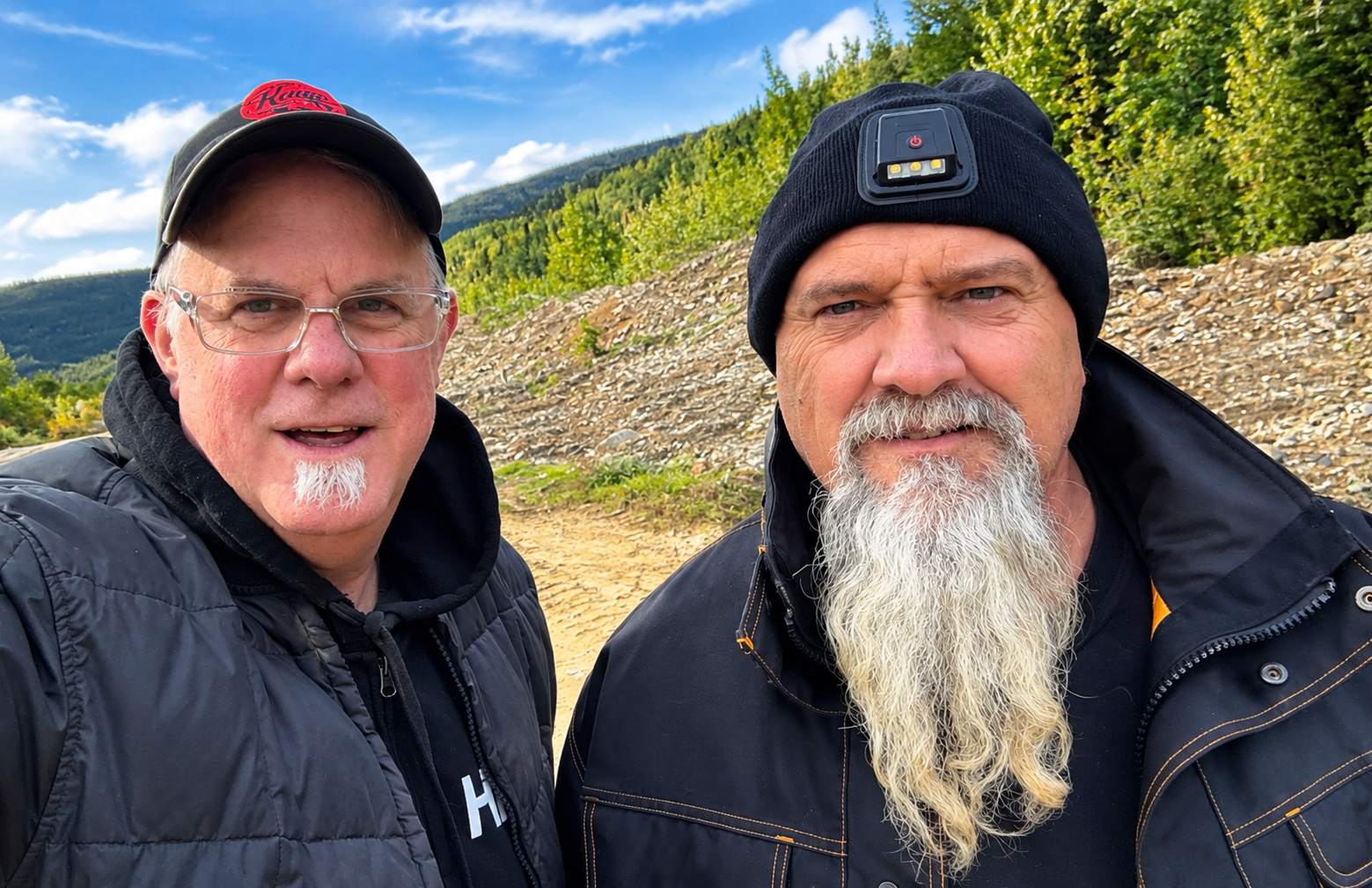
I couldn’t stop thinking about that word, overburden, long after I left the mine. It’s a good name for it, honestly. Not garbage, not worthless in every sense, just dirt and rock that has to be moved before anything valuable can be reached. We carry our own overburden too. Worry we’ve hauled around for years. Old hurts we never quite set down. Distractions and doubts and fear, the same fear I felt driving that road alone, all of it sitting right on top of whatever God actually wants to do in us. None of it is necessarily evil. Most of it is just weight, dead ground piled on top of the good ground underneath. And the mine doesn’t skip that step. Nobody gets to the pay dirt without first moving the overburden out of the way. I don’t think we do either.
I got to stand in the gold room and watch the very last step of that process happen in real time, and then I got to shift through a couple of pans myself. I watched the water and grit swirl away and that unmistakable yellow finally show up against the bottom of the pan. It’s a small moment, but it doesn’t feel small when you’re the one holding the pan. That’s the answer, right there in your hands, after everything it took to get to it. That’s the real payoff of this trip. Not just the podcast footage, though I got plenty of that too. The payoff was everything I would have missed entirely if I’d never said yes: the rock trucks, the drone shots over the valley, the beavers stacking their dam for winter, the stars so clear and close they didn’t look real, the conversations with Todd and his crew.
Just Say YES!
None of it happens if I don’t say yes to Todd, if I don’t trust a GPS pointed at a dirt road with no address, if I don’t push through the fear on that long, empty stretch of highway.
And maybe that’s the whole point underneath all of it. The overburden has to be moved before you ever see the gold, in the ground and in us. The unknown road has to be driven before you reach the camp. The fear has to be walked through, not around. The worry and the old weight we carry has to be set down again and again, the same way that mine clears ground every season.
If the unclear way, the longer road, and the fear along it are enough to make us turn back, we may never see the gold. We may never see the victory.
But when we say yes, even with the way unclear, even when it takes longer than we expected, even carrying more than we wished we had to carry, we get to see the gold. We get to see the victory.
Dave Almgren – Two Pastors, Popcorn and a Movie Podcast