
Most of us know the name Nicholas because of Christmas. Long before red suits and reindeer, there was a real man, a fourth-century bishop named Nicholas of Myra, in what is now Turkey. He was known for his quiet generosity. The best-known story says he heard about a poor father who couldn’t afford dowries for his three daughters, and he secretly tossed bags of gold through their window at night. That story of hidden, humble giving grew over the centuries into the Santa Claus we know today.
But there’s another story connected to his name, one that has nothing to do with chimneys and everything to do with freedom. It happened in a church named after him in Leipzig, East Germany. And it helped bring down the Berlin Wall.
A Church for Travelers and Merchants
Nicholas became the patron saint of merchants and travelers, so towns built around trade often dedicated churches to him. Leipzig was one of those towns. It sat where major trade routes crossed in the heart of Germany, and around 1165 the city built St. Nicholas Church, the Nikolaikirche.
Over the centuries the church saw a lot of history. Martin Luther preached in Leipzig. And Johann Sebastian Bach, who was born in Eisenach, spent the last 27 years of his life in Leipzig as the city’s music director, responsible for the music at St. Nicholas and St. Thomas. On Good Friday in 1724, Bach premiered his St. John Passion at St. Nicholas Church, a towering musical retelling of the suffering and death of Jesus. He signed his work SDG, Soli Deo Gloria: to God alone be the glory.
So this was already a church soaked in faith and music. Nobody could have guessed that its most famous chapter was still to come.
Life Behind the Wall
After World War II, Leipzig ended up in communist East Germany. The government didn’t close the churches outright, but it made faith costly. Young Christians could lose places at university. Believers were passed over for jobs. The secret police, the Stasi, kept watch on church gatherings and planted informers among congregations. The message was clear: you can believe if you must, but keep it quiet and keep it small.
And yet the churches became one of the few places in East Germany where people could speak with any honesty. Inside those walls, people gathered to pray, and prayer has a way of making people brave.
Monday Prayers for Peace
In 1982, St. Nicholas Church began holding peace prayers every Monday evening. At first they were small. A handful of people, often young, came to pray about the arms race, the environment, and justice. Pastor Christian Führer welcomed them, and the church took on a simple motto: “open to all.” Anyone could come, believers and non-believers alike, including people who simply had nowhere else to speak freely.
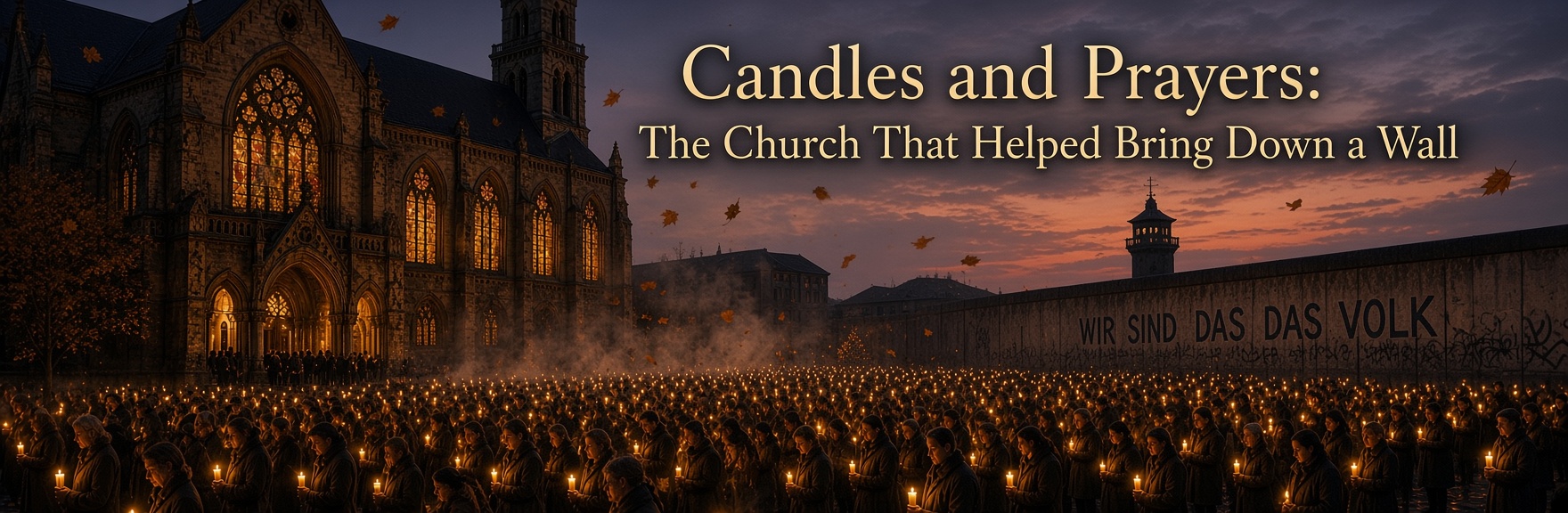
For years the meetings stayed small. But they never stopped. Every Monday, the doors opened and people prayed. By 1989, as frustration across East Germany boiled over, those Monday prayers began to overflow. After each service, people spilled out into the square with candles in their hands. The Monday prayers had become the Monday demonstrations.
October 9, 1989
The night everything changed was Monday, October 9, 1989. The government had made it clear it was ready to crush the protests. Troops and police were in position. Hospitals had reportedly been told to prepare extra blood. Many feared a massacre like the one in Tiananmen Square only four months earlier.
That evening, St. Nicholas Church was packed. Party members had been sent in to fill the pews, but they heard the same Sermon on the Mount as everyone else: blessed are the peacemakers. When the service ended, people stepped outside and found the square full. About 70,000 people marched through Leipzig, holding candles and chanting, “No violence!” and “We are the people!”
Carrying a candle takes two hands. One to hold it, and one to shield the flame. You can’t throw a stone while you’re doing that. As East German official Horst Sindermann later put it, “We had planned for everything. We were prepared for everything. But not for candles and prayers.”
The order to shoot never came. The crowd walked the ring road around the city centre and went home. A week later, 120,000 marched. Then more. Exactly one month later, on November 9, 1989, the Berlin Wall opened.
What a Candle Can Do
I love that this happened in a church named for Nicholas. The bishop who gave in secret, without fanfare, has his name on a church where ordinary people quietly prayed, week after week, for seven years, with no idea it would change the world.
That’s usually how God works. Not with armies, but with faithfulness. Not with one dramatic moment, but with a door that keeps opening every Monday night. The prophet Zechariah put it this way: “Not by might nor by power, but by my Spirit, says the Lord Almighty” (Zechariah 4:6).
It’s worth asking: what small, faithful thing am I doing that I might be tempted to quit? A prayer group of five. A Sunday school class nobody notices. A Bible study around a kitchen table. St. Nicholas Church reminds me that small, steady prayer is never wasted.
A Closing Thought
This Christmas, when you see Santa Claus, remember the real Nicholas. And remember the church that bears his name, where candles and prayers did what tanks and guns could not.
The light still shines in the darkness, and the darkness has not overcome it (John 1:5).
Soli Deo Gloria.
Dave Almgren – FaithandFamilyFlicks.com & Two Pastors, Popcorn and a Movie Podcast

