

There are two hospital rooms in this story, separated by an ocean and about twenty years.
In one of them, a couple in Australia is being told that their newborn son has no arms and no legs, and that nobody can tell them what his life will hold. In the other, my wife and I are being handed a diagnosis for our daughter, along with the careful language about all the things she might never do.
In both rooms, the same unspoken question is sitting in the corner. What kind of life is this going to be?
I have spent years learning that we were asking the wrong question.
Broken, by the world’s math
Our daughter Grace lives with Down syndrome.
We live in a culture that says, with startling consistency, that a diagnosis like hers is a problem to be solved before the child arrives. Abort. Abort. Abort. That is the cultural default, and it is delivered as compassion.
In that other hospital room, the one in Australia, the doctors could offer no explanation and no prognosis. Nobody could say whether he would have a life worth living, would he ever marry, or become a father, or what his life might hold. By the same cultural math, he was a tragedy.
His name is Nick Vujicic, and his story is in theaters now across the country.
And there is a question that has been following me around ever since I first heard it:
What if the thing you spent your life trying to fix is the very thing God wants to use?
Sit with that for a second. Not the thing you overcame. Not the thing you worked around. The thing you would have handed back if the returns desk had been open. The thing you have quietly asked God to remove, maybe for decades.
What if that is the point?
No arms, no legs, being the hands and feet of Jesus
Somebody described Nick to me as a guy born with no arms and no legs who has spent his life trying to be the hands and feet of Jesus. That statement hit me right between the eyes, and then I got quiet, and contemplated these words and their meaning in my life.
The church has used that phrase for generations. Be the hands and feet of Jesus. Go do the work. And here is a man with neither, who has carried more hope into more countries than most of us with fully working limbs will manage in a lifetime.
He did not get there by pretending it was easy. Nick has been open about the years between eight and thirteen when depression crushed him. He convinced himself there was no hope, and that if God existed at all, He was unfair. He prayed for a miracle, and the miracle did not come.
What came instead was a shift in perspective. At thirteen, Nick hurt the one small foot he does have, and he realized he needed to be thankful for what he had instead of angry about what he didn’t. Then he read the story of the blind man in John 9 and landed on a simple conclusion: if God had a plan for a blind man, God had a plan for him.
The limbs never grew. The lens changed.
Two wings of the same airplane
Two truths fly together here, like the two wings of the same airplane.
The thing you would fix is the thing God uses. And the person the world writes off becomes the one carrying hope to everybody else.
Nick is the proof at full volume. But I did not have to fly to Australia to watch it happen, because the same thing has been going on quietly in my own living room for twenty-six years.
Right between those two wings is a young woman with an extra chromosome and a violin.
Grace taught herself to play by watching videos. At our previous church she wanted to be part of worship, and a compromise was reached: she could play from the balcony, from her seat, during the worship set. She accepted immediately. The balcony would do.
So every Sunday she carried that violin up the stairs like she was carrying something important, because she was. She sat down, lifted it, and worshiped. People started glancing up mid-song and seeing a young woman with her eyes closed and her bow moving, lost in something that had nothing to do with performance.
Some of them came to us afterward in tears. Then we told them the part they had not realized. There are no strings on that violin. She had been offering completely silent worship, week after week, and it was moving a congregation.
It went further. At a pastors’ conference, Grace was sitting in the back with her mom while the worship team rehearsed, playing along from her seat the way she always does. Somebody noticed. They walked back and invited her to come up and play with the band, in front of three thousand ministry leaders.
She did not hesitate. She walked to the front, took her place, lifted a violin that makes no sound, and played. Many in that crowd were undone. Some wept. Others were visibly moved.
I think about those first questions in the hospital room. Will she have a life? Will she make an impact? We did not know based on the information we had at the moment. But we would soon discover that Grace was destined to make an impact. We just could not see it yet.
God is not looking for perfection. He is looking for a heart that is fully His. Grace offers that every single time, no strings attached.
Cleaning the lens
Most of us are not walking around in despair. We are walking around with a smudged lens. The glass isn’t shattered. It’s just dirty enough that everything looks a little worse than it is.
The work stress, the bills, the family tension, the thing that didn’t go our way this week. It all looms large because we’re looking through a film of grime we stopped noticing years ago.
Then a story like Nick’s, or a moment like Grace in the balcony, comes along and wipes the glass clean.
I want to be careful here, because there’s a cheap version of this I refuse to write. The cheap version says: look at that man with no arms and no legs, so your problems are nothing, buck up. That isn’t perspective. That’s dismissal, and it helps nobody.
Your struggle is real. The anxiety that makes mornings hard is real. The diagnosis, the treatment schedule, the grief nobody at work knows about. Autism, cancer, depression, loss. None of it gets waved off because someone else has it harder. Suffering isn’t a competition, and there’s no trophy for placing.
But there’s a difference between minimizing your circumstances and enlarging your frame.
Bethany Hamilton, who lost her arm to a shark attack and went back to surfing anyway, says it in five words: “I don’t need easy, I just need possible.” That is not denial about how hard it is. It is a refusal to call it over.
Nick and Grace don’t shame anyone into gratitude. They widen the picture. They show, in public and at real cost, that joy isn’t the absence of hardship, and hope doesn’t wait for circumstances to improve. Nick puts it this way: hope without Jesus means waiting for your situation to change. Hope with Jesus doesn’t need the situation to change at all.
So here’s the question worth carrying into the weekend. Not why is my life hard? but:
In the middle of hard, how do I keep the joy?
Grace answers it every morning. She wakes up smiling and asks what’s next, already leaning into the day. Nick answered it at thirteen, with one small foot and a story about a blind man.
What they can do
Here is what I notice about Grace and about Nick. Neither story is really about what they cannot do. Both are about what they can.
A girl who was not supposed to amount to much helps to lead a room in worship. A man born with no arms and no legs carries hope around the world, being the hands and feet of Jesus.
That is not a lesson about limitation. That is a story about possibility, and possibility is just another word for hope.
The rest of Nick’s story
What I have given you here is only a sliver of Nick’s story. His whole story is on the big screen now, and it is worth ninety minutes of your evening. You will walk out carrying more hope than you walked in with, and you will see your own life a little differently on the drive home.
No Limbs, No Limits: The NickV Story is in theaters nationwide starting today (September 25th). Take your spouse. Take your small group. Take the teenager in your house who is carrying more than they let on, or consider taking the person you know who needs some hope today.
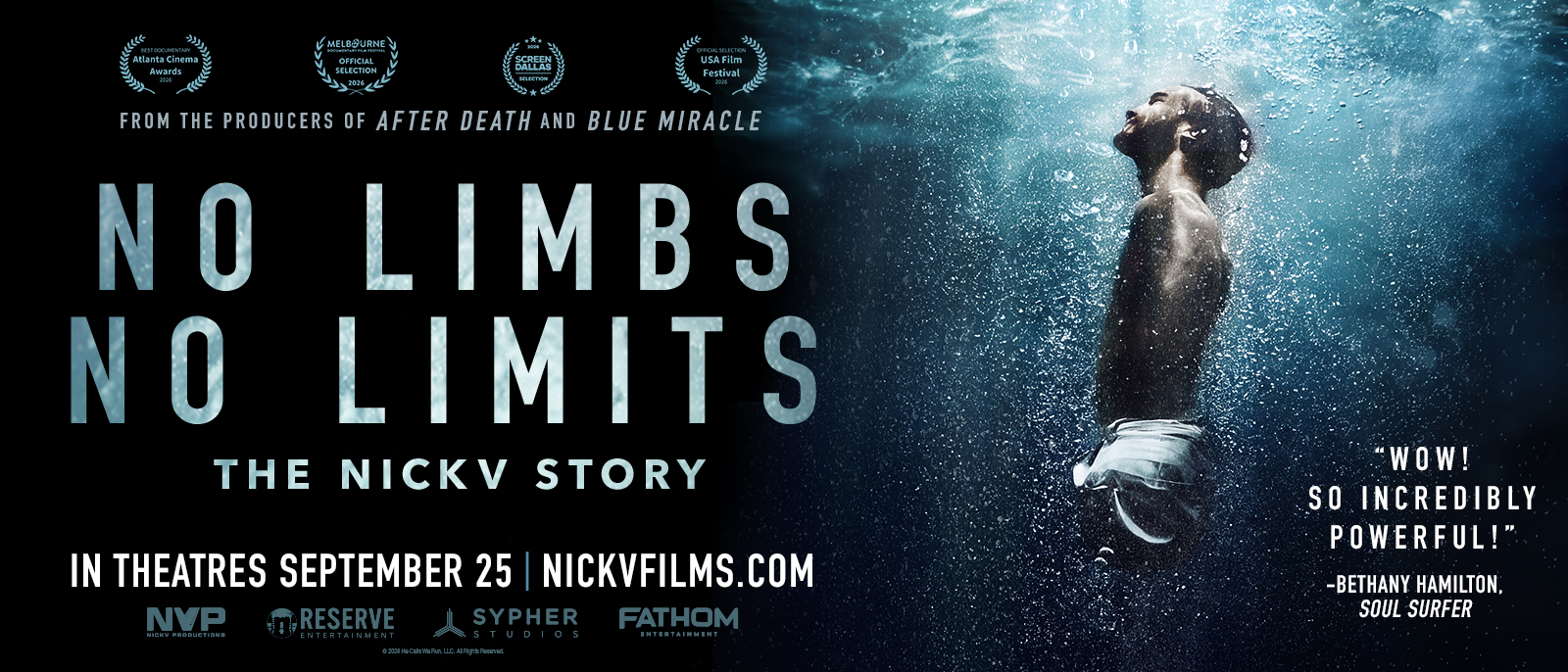
Then go home and ask the question the film asks: what is the thing you’ve spent your life trying to fix?
Because it might not be the obstacle in the way of your purpose. It might be the instrument.
Even without strings.
Dave Almgren – Two Pastor, Popcorn and a Movie Podcast

