
I have a piece of metal sitting on my desk. If you picked it up, you might not think much of it. It’s a few welded rods that cross each other and make a pattern of diamonds, each one about the size of a silver dollar. It’s a little rough and a little heavy, the kind of thing you’d walk past in a scrapyard.
But I’ve hung on to it for more than thirty years, because it isn’t just a piece of metal. It’s a piece of the fence that once divided East and West Germany. And when I hold it, I’m holding a story about oppression, about freedom, and about a small German town that gave the world more than most people realize.
Lately I’ve been going through what I call my walls of memory, the moments and keepsakes that shaped me. Some of them, like meeting the people behind Mister Rogers’ story, remind me of kindness. This one reminds me of freedom. Let me tell you how I got it.
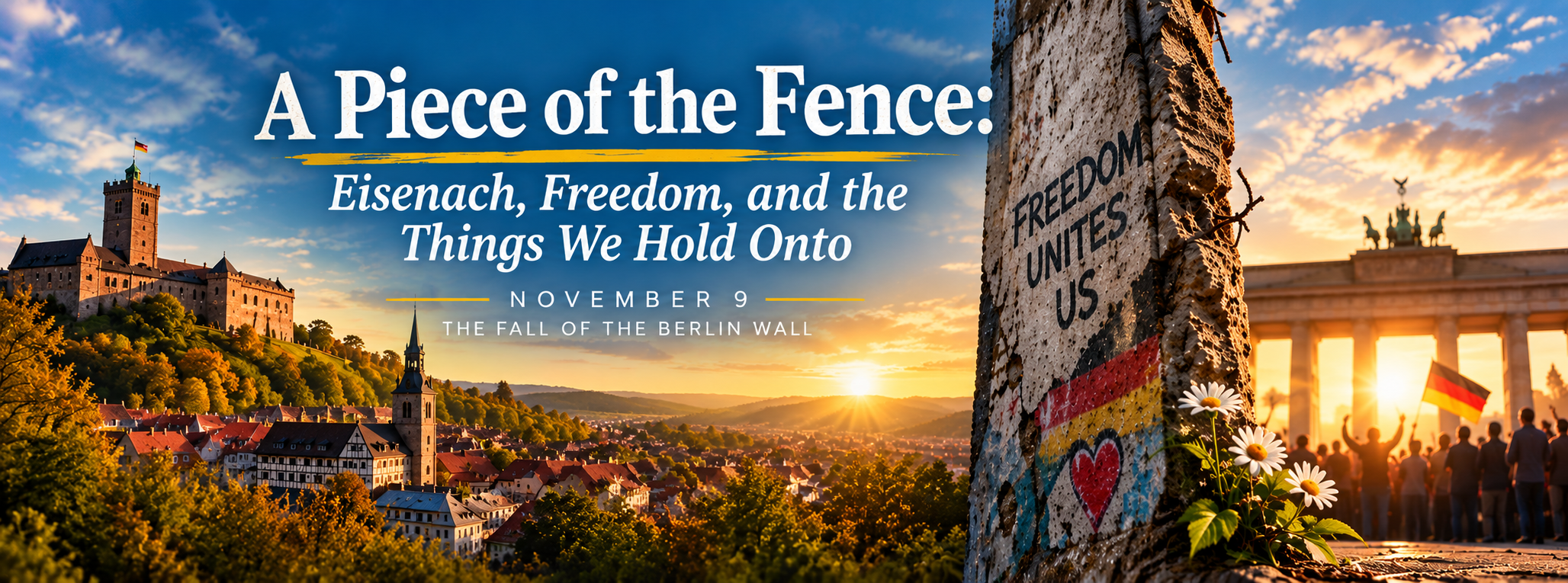
A Trip Across a Disappearing Border
It was around 1989 or 1990, just after the Berlin Wall came down. The world had watched in amazement on November 9, 1989, as East Germans climbed onto the Wall and chipped away at it with hammers. Families who’d been separated for decades were embracing at checkpoints. Something that had seemed permanent was crumbling in front of everyone’s eyes.
We drove over from West Germany into what had been East Germany, something that would have been unthinkable only a short time before. We visited with some local folks, and they offered to show us where the border had been.
They picked us up in a Trabant. If you’ve never heard of a Trabi, it was the classic East German car: tiny, boxy, and loud. Our hosts explained that you didn’t just walk into a dealership and buy one. You put in an order and waited, often ten years or more. People saved for a long time and then waited even longer, just for a little car. They joked that the body was made of cardboard, and that if you hit it hard enough you could put your fist right through it. It was actually a hard plastic, but sitting inside it, I believed the joke.
That car told me a lot about life in East Germany before I ever saw the border. Even something as ordinary as getting a car was controlled, rationed, and delayed.
The Fence
In Berlin, the Wall was concrete, solid, and imposing. But out in the countryside around Eisenach, the border looked different. It was a fence about ten feet high, made of welded metal in a diamond lattice. Watchtowers stood along it, close enough together that guards could keep an eye on every stretch.
Between the road and the fence was what people called the death strip. You didn’t walk into it. You didn’t wander toward the fence. There was no reason to be there except one: to try to escape. And people who tried were shot.
Standing there, our hosts asked us, “Do you want a souvenir? A piece of the fence?”
I remember the strangeness of that moment. Only months earlier, if I had walked up to that fence and tried to take a piece of it, I’d likely have been shot. Now it was being offered to me as a keepsake. The same fence that had held people in was being taken apart by the very people it had imprisoned.
So I took my piece. And I’ve kept it ever since.
A Town With a Remarkable History
It was only years later that I really appreciated where I had been standing. Eisenach isn’t just any town in Thuringia. It has a story that reaches deep into the history of faith and music.
Martin Luther went to school in Eisenach as a boy. Then in 1521, after he refused to take back his writings at the Diet of Worms, Luther was declared an outlaw. His life was in danger. His protector, Frederick the Wise, arranged a staged kidnapping and hid him away in Wartburg Castle, high on a hill above Eisenach.
Disguised as a knight called “Junker Jörg,” or Knight George, Luther did something extraordinary. In about eleven weeks he translated the New Testament from Greek into German. For the first time, ordinary German families could read the Word of God in their own language. They no longer had to depend on someone else to tell them what it said.
Think about that. Eisenach is a place where the Scriptures were set free and placed into the hands of the people.
And then there’s the music. In 1685, Johann Sebastian Bach was born in Eisenach and baptised at St. George’s Church, the same church where Luther had preached. Bach would go on to write some of the most beautiful music the world has ever heard, much of it for the church. At the end of many of his manuscripts he wrote three letters: SDG. Soli Deo Gloria. To God alone be the glory.
So this one small town gave the world the Bible in the language of the people and music written for the glory of God.
From Freedom to Fences
That’s what makes my little piece of metal so striking to me.
The same region that gave birth to Luther’s German New Testament and Bach’s music ended up, centuries later, behind a fence. After World War II, Eisenach found itself in East Germany, just a few miles from the border with the West. For four decades, its people lived under a government that watched them, limited where they could go, and pushed faith to the margins. Churches weren’t outlawed, but believers often paid a price for their faith in their schooling, their jobs, and their futures.
The place where the Word had been set free was now fenced in.
I don’t want to overstate it. God was never fenced in. Faithful believers kept praying and gathering throughout those years, and in the fall of 1989, candlelit prayer meetings in East German churches grew into the peaceful protests that helped bring the Wall down.
There’s something deeply fitting about that. The freedom that came to East Germany didn’t just come from politics. It came, in part, from people of faith who refused to stop hoping.
What a Fence Can Teach Us
When I hold this piece of fence, I think about how people get used to walls. When you live behind one long enough, it starts to feel normal. You stop imagining life on the other side. You put your order in for a car and wait fifteen years, and that becomes just how things are.
I think many of us live with fences of our own. They might not be made of welded metal, but they’re just as real. Fear. Shame. Bitterness. Old habits. Lies we’ve believed about ourselves. Sometimes we’ve lived with them so long we don’t even see them anymore.
But Jesus said, “So if the Son sets you free, you will be free indeed” (John 8:36). And Paul wrote, “It is for freedom that Christ has set us free. Stand firm, then, and do not let yourselves be burdened again by a yoke of slavery” (Galatians 5:1).
Freedom is God’s heart for His people. It was true in Luther’s day, when ordinary people were finally given the Scriptures in their own language. It was true in 1989, when a fence that seemed permanent was torn down. And it’s true today, for anyone living behind a wall they never thought would come down.
Why I’ve Kept It
I’ve moved, changed careers, and gone from kids’ ministry to film marketing over the years. A lot of things have come and gone. But this piece of metal has stayed with me.
Maybe it’s because it reminds me that what looks permanent often isn’t. Regimes fall. Fences come down. Things that seemed impossible become history.
Maybe it’s because it reminds me that God’s Word and God’s glory outlast every wall people build. The New Testament Luther translated in Eisenach is still being read. Bach’s music, written to the glory of God, still fills churches and concert halls. The fence that tried to contain that town is now souvenirs on people’s desks.
And maybe it’s because I want my kids and grandkids to understand that freedom isn’t something to take for granted. People risked everything for it. Some died trying to reach it. And when it finally came, it came with candles, prayer, and hope.
A Closing Thought
So here’s my question for you: what fence are you living behind?
Maybe you’ve gotten so used to it that it feels normal. Maybe you’ve stopped imagining life on the other side. But walls do come down. I’ve held a piece of one in my hand.
Eisenach gave the world the Word in the language of the people and music for the glory of God. For a while it was fenced in. And then, by God’s grace, it was free again.
May the same be true for you.
Soli Deo Gloria.
Dave Almgren – Two Pastors, Popcorn and a Movie Podcast & FaithandFamilyFilms.com

