
I watched The Odyssey recently, and it sent me straight back to one of the oldest stories in Western civilization, a story that, oddly enough, has never felt more relevant to the American family than it does right now.
You know the tale, even if you haven’t thought about it in years. After a decade of failed siege, the Greeks couldn’t break through the walls of Troy by force. So they got creative. They built an enormous wooden horse, hid their best soldiers inside its hollow belly, and left it at the gates as a “gift”, a peace offering, a symbol of surrender. The Trojans, weary from war and hungry for good news, hauled it inside their own walls. They celebrated. They let their guard down. And that night, the soldiers climbed out and opened the gates to the rest of the Greek army. Troy, a city that had withstood ten years of siege, fell in a single night — not because the enemy overpowered them, but because the Trojans invited the danger in themselves.
Here’s something interesting: the Trojan Horse barely gets a mention in Homer’s Odyssey, just a passing reference. Homer’s Iliad ends before Troy even falls. It’s actually the Roman poet Virgil, writing centuries later in the Aeneid, who gives us the full story we know today. And it’s Virgil who gives us the line that’s echoed for two thousand years: “Timeo Danaos et dona ferentes”, “I fear the Greeks, even when they bear gifts.” A Trojan priest named Laocoön said it, warning his people not to trust the horse. Nobody listened. He was right, and it cost his city everything.
I don’t think that line was written just for ancient Troy.
I think it was written for us.
The Gifts We Welcomed Inside
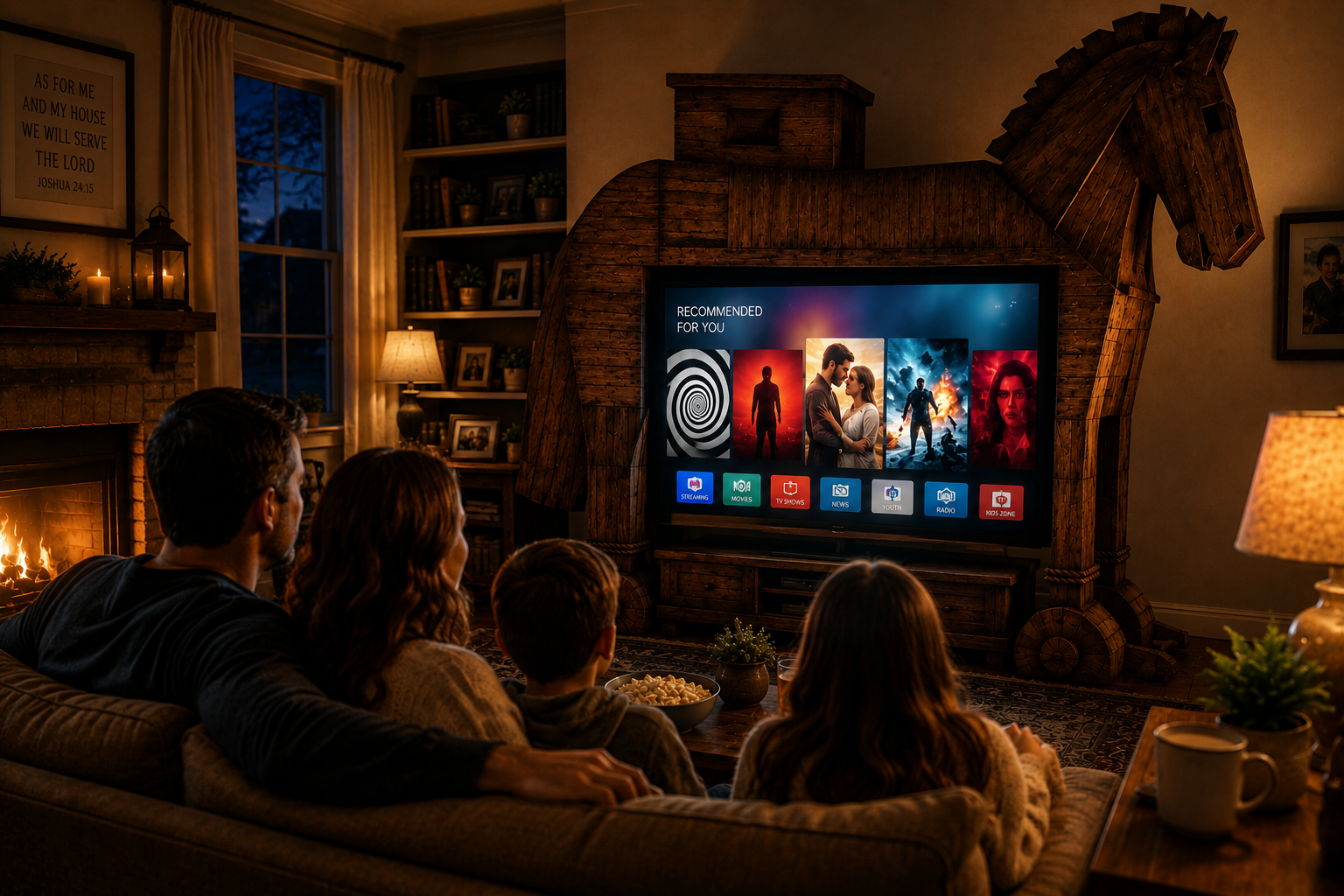
Think about what’s crossed the threshold of the American home over the last twenty years. The smartphone. The streaming service. The endless scroll. Each one arrived looking like a gift, connection, convenience, entertainment, a window to the whole world in your pocket. And in a lot of ways, they are gifts. I don’t believe a phone or a TV is inherently evil any more than a wooden horse is inherently evil. It’s just wood. It’s just glass and circuitry.
But a gift is only as good as what’s hidden inside it. And for years now, we’ve been wheeling these things through our front gates without asking the one question Laocoön asked: what’s actually inside this?
Because something got in. Quietly. While we were busy celebrating the convenience, the entertainment, the connection, nefarious actors climbed out of the horse and got to work. Not the device itself, but the people and forces using it with intention, working to reshape how our kids think, what they value, how they see themselves, and what they believe is normal. We didn’t see it happen because it wasn’t a battering ram at the gates. It was a gift we brought inside ourselves.
If that theme sounds familiar, it should. It was basically the whole point of the 2025 film that had families talking, the quiet, creeping way devices steal children from their parents’ laps and their families’ tables without a single dramatic moment marking the loss. No siege, no battle. Just a slow opening of the gates from the inside, one notification at a time.
More Connected, More Alone
Here’s the line that should stop us cold: we have never been more connected as a culture, and we have never been lonelier. We carry the entire world in our pockets, and yet deep, meaningful relationships, the kind that used to define neighborhoods, churches, and families are quietly disappearing. We’re tethered to hundreds of people online and estranged from the ones sitting across the dinner table.
That’s the Trojan Horse working exactly as designed. The gift promised connection but delivered isolation instead.
Say that one out loud. Sit with it for a second. Because that’s not just a clever turn of phrase, that’s the diagnosis. That’s what happened to Troy, and it’s what’s happening in living rooms across this country. The horse didn’t look like an invasion. It looked like a blessing. And by the time anyone realized what was inside it, the gates were already open.
What’s the Horse in Your Home?
I’m not writing this to make you throw your phone in the driveway or cancel every streaming subscription tonight. That’s not the point, and honestly, it’s not realistic. The Trojans weren’t wrong to want peace. They were wrong to stop asking questions the moment something looked like a gift.
So here’s the challenge: name the horse in your home. Maybe it’s a device. Maybe it’s a show your kids watch without you ever having watched an episode yourself. Maybe it’s the algorithm quietly shaping your teenager’s sense of identity while you assume it’s “just entertainment.” Whatever it is, don’t just wheel it through the gate and celebrate. Look inside it. Ask what it’s actually carrying, and who benefits from what it delivers into your family’s life.
Judeo-Christian culture in America wasn’t sacked in a single battle. It’s been a slow, patient siege and like Troy, the walls didn’t fall because the enemy was stronger. They fell because we stopped asking what we were letting inside.
Troy fell in one night. But it took ten years of exhaustion to get them to accept the gift.
Don’t be exhausted into complacency. Ask the question Laocoön asked. Look inside the horse before you bring it through the gate.
Dave Almgren – Two Pastors, Popcorn and a Movie Podcast

